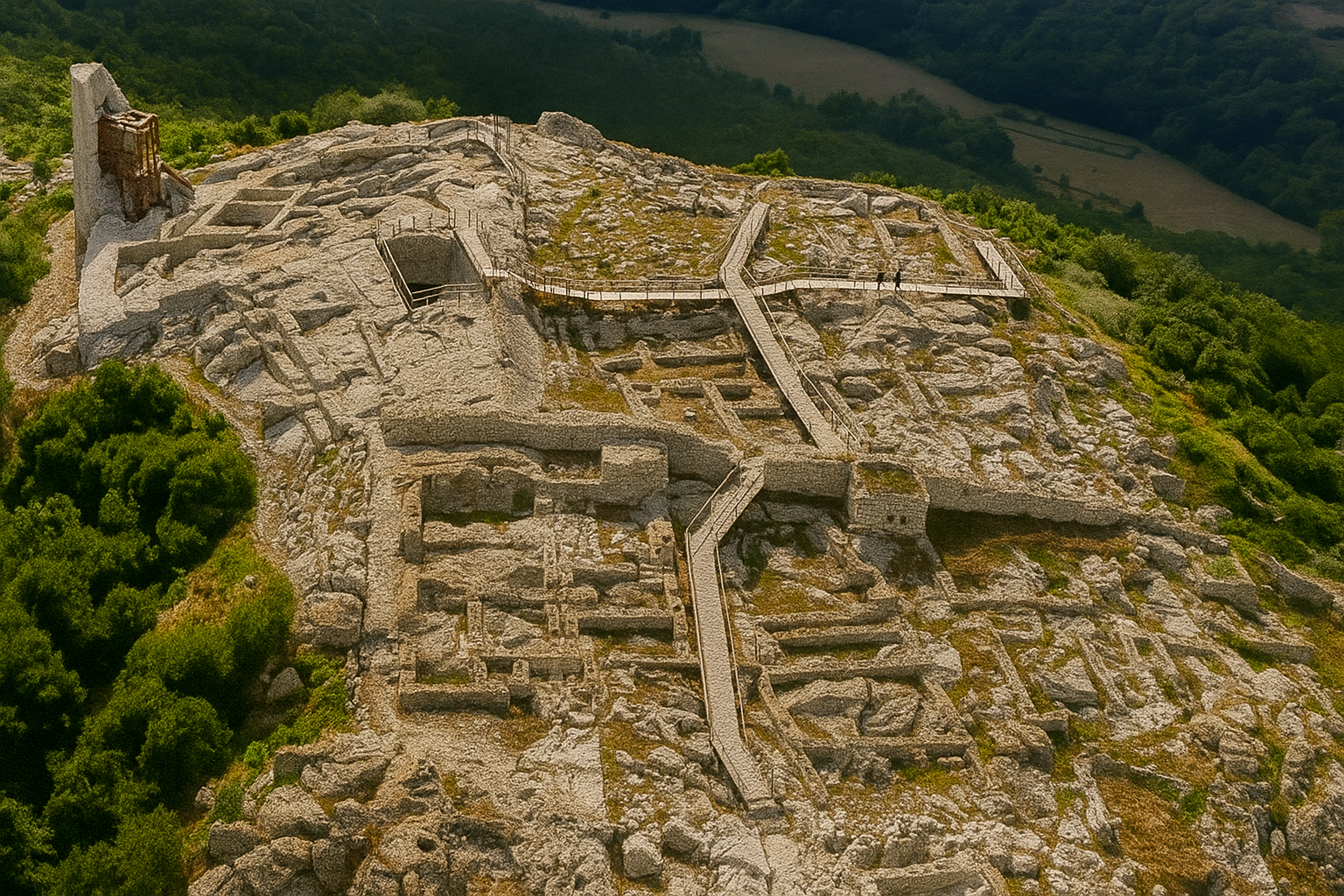
Perperikon is one of the most significant archaeological sites in Bulgaria—and indeed, in all of Europe. This ancient rock city, nestled in the Eastern Rhodope Mountains, tells the story of many civilizations that left their mark upon it. Over the centuries, it has served as a sacred site, a cult center, a fortress, and even a medieval city. It is precisely this multifaceted historical role that makes Perperikon a place steeped in intrigue and mystery today.
Geography of Perperikon
Perperikon lies in southern Bulgaria, about 15 kilometers northeast of the town of Kardzhali, perched atop a hill rising 470 meters above sea level. Its stone-carved structures are truly unique and stand as a testament to its millennia-old history. The complex is divided into several major sections: the Acropolis, the Palace, the temples, and the residential quarters. Archaeologists have uncovered the remains of buildings, water reservoirs, streets, and stairways carved directly into the rock, along with a wealth of artifacts that prove Perperikon was inhabited for centuries.
Development
The story of Perperikon begins over 8,000 years ago, dating back to the Neolithic period. During the Bronze and Iron Ages, the site served as a religious center devoted to the worship of various deities. In the era of the Thracian civilization (2nd–1st millennium BCE), Perperikon became one of the most important sanctuaries dedicated to the god Dionysus. Some scholars believe this was the location of a great oracle. According to historical sources, it was here that Alexander the Great received a prophecy foretelling his military triumphs and conquests.
During the Roman era (1st–4th century CE), Perperikon retained its importance as a religious hub and gradually evolved into an administrative center. With the arrival of the Byzantines, the site was further fortified, and later, in the Middle Ages (10th–14th century), it was transformed into a mighty fortress with monumental walls, towers, and palaces.
Archaeological discoveries
Though the first archaeological interest in Perperikon dates back to the early 20th century, systematic excavations did not begin until 2000, under the leadership of Professor Nikolay Ovcharov. Numerous artifacts have been discovered—ceramics, coins, bronze and gold objects—all bearing witness to the vibrant life of the ancient city. One of the most important finds is a monumental altar, believed to have been used for wine and fire rituals in honor of Dionysus. Remains of an early Christian basilica have also been found, confirming that Perperikon later became a center of Christianity.
The mystery
Perperikon remains shrouded in mystery, fueled by legends surrounding the site. Historians and researchers believe that rituals and prophecies involving wine and fire were conducted here—similar to those at the Temple of Apollo at Delphi. One particularly captivating hypothesis suggests that Perperikon was the epicenter of the Thracian cult of Dionysus and a key site for Orphic rituals. Some scholars even argue that it was part of the lost kingdom of the Bessi.
Perperikon today
Today, Perperikon stands as one of Bulgaria’s most visited tourist attractions. It draws thousands of tourists, historians, and archaeologists from around the world. Excavations are ongoing, and each year new discoveries shed more light on the history of Perperikon and the ancient world that once thrived there.
Perperikon is far more than just an archaeological site, far more than a collection of massive stones—it is living history. It is a place where mysticism and reality intertwine, creating a unique atmosphere that continues to inspire explorers and visitors alike. With each new archaeological revelation, this ancient city unveils a bit more of its secrets, reminding us that the past still has much to say.
Source of cover photo: http://nasledstvotonanaroda.bg/nature/preotkrii-bulgaria/perperikon/